Essay
Small Thoughts from a Car Maintenance Bill
My cheap self disagreed with a financial decision.
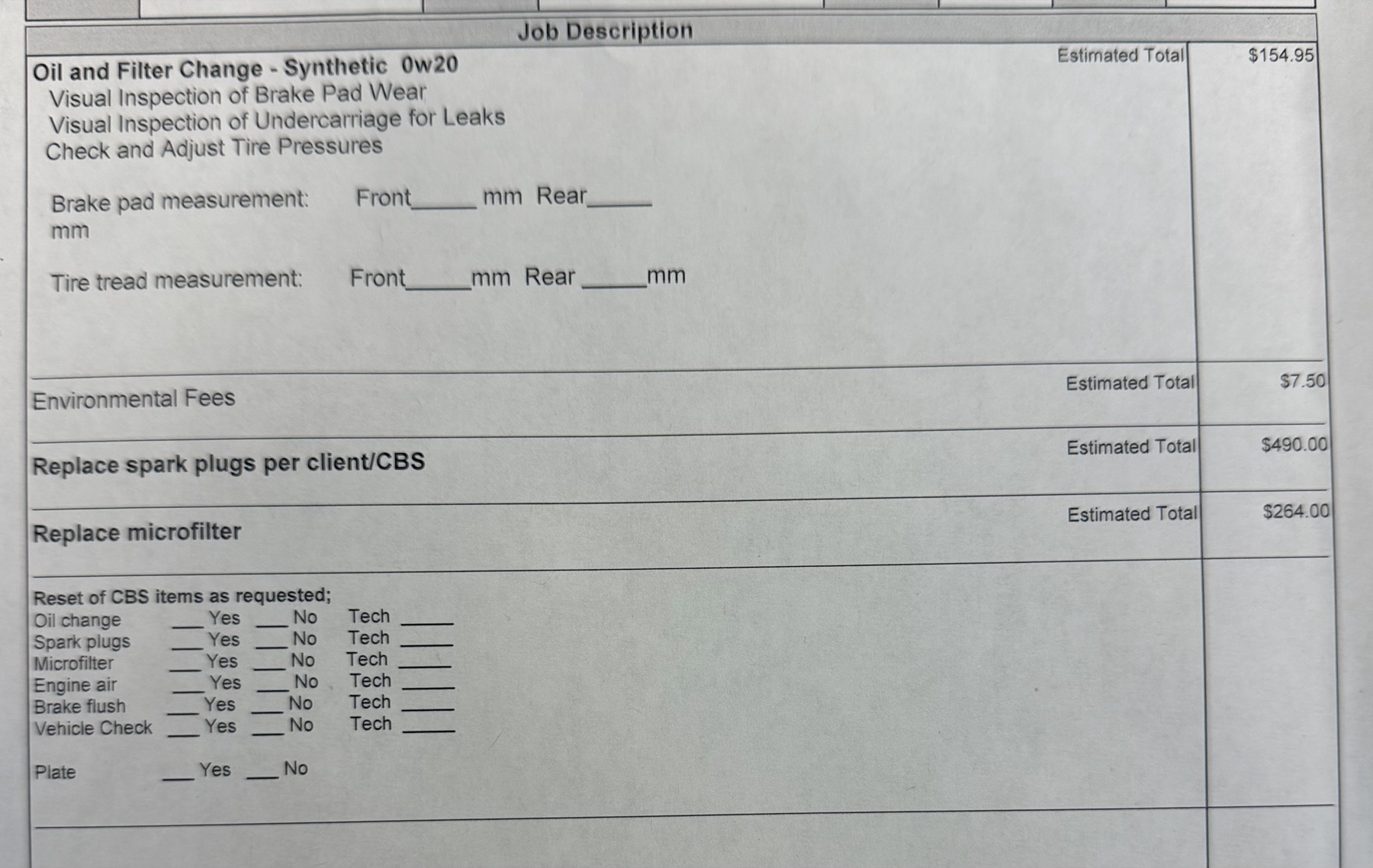
Today I took my wife’s BMW in for service.
Oil change, spark plugs, cabin filter. The bill was about $916.
That number didn’t shock me. BMW maintenance is expensive. What stayed with me was the familiar little debate underneath it: should I have just done this myself?
Ten or twenty years ago, I probably would have looked at that question very differently. Back then, a few hundred dollars carried a lot more weight. Saving money had a much more obvious moral clarity to it. If I could do something myself and avoid paying someone else, that was usually the right answer, or at least it felt like the right answer. Also, to be fair, ten or twenty years ago I couldn’t have afforded a BMW in the first place.
Now the decision feels different. Not because money no longer matters, but because the tradeoff has changed shape. The younger version of me would have focused on the savings. The current version of me is more likely to wonder whether I really want to give part of a weekend to spark plugs.
That’s one of the stranger parts of getting older. The same decision can stay materially similar while feeling psychologically different. I’m not just reevaluating the task. I’m reevaluating it as a different person.
And to make things more confusing, a lot of these tasks are easier to approach than they used to be.
I probably could have done the work myself. Not because I’ve secretly become a mechanic, but because the barrier to learning basic things is so much lower now. There are YouTube videos for almost everything. Not vague videos either — the exact car, the exact part, the exact tools, someone calmly explaining what to remove first and what not to overtighten. ChatGPT helps too. It doesn’t give me judgment or experience or magically unstick a bolt, but it does make a lot of basic learning much more accessible. It can get me oriented fast enough that something formerly mysterious starts to feel merely inconvenient.
Last year I replaced the cabin air filter on my Model 3 after watching a video. It was easier than I expected. Not one of those triumphant movie moments where I suddenly discover hidden mechanical genius. More like: huh, that was it?
That’s part of what makes these small decisions weirder now. More things live in this middle zone where they are no longer clearly specialist-only tasks, but they’re also not effortless. They’re possible. Which sounds empowering until I realize that “possible” is not the same thing as “worth doing.”
That was really the question with the BMW.
Doing it myself wouldn’t have just meant changing the oil and replacing spark plugs. It would have meant watching the right videos, confirming the parts, making sure I had the right tools, setting aside time, cleaning up afterward, and hoping the whole thing stayed as straightforward as it looked online. Every DIY project comes with a little cloud of surrounding effort. The task itself is only part of the task.
But paying someone else didn’t remove that cloud either. It just turned it into a different cloud.
I still had to research where to take the car. I used ChatGPT to help find a nearby BMW specialist with good reviews. I compared prices, scheduled the appointment, then drove about thirty minutes each way. Later my wife mentioned that the dealership had texted about a recall, which meant we were going to need a dealership visit anyway.
So even the supposedly simpler option came with its own trail of logistics. Less grease, more calendar management.
That’s the part I kept thinking about afterward. The visible price was clear enough. The actual cost wasn’t.
Money is easy to count. Time is fuzzier. Attention is fuzzier still.
A lot of small decisions look like money decisions because money is the cleanest part of the picture. The bill is right there. The savings are easy to imagine. But the rest of the cost tends to arrive in fragments. A few minutes here, half an hour there, a drive across town, some research I tell myself is being responsible, a low-grade sense of administrative drag.
And then, just to make the whole thing even less tidy, not all time feels the same once I’ve spent it.
About a year ago, when we moved to a place that’s not especially close to any car wash, I started washing the car at home more often. The nearest one is about fifteen minutes away, so by the time I drive there and back, I’ve already spent half an hour. After a while, doing it at home stopped feeling like some noble but inefficient DIY choice. It felt more or less neutral on time.
Then it started to become something else. I found that I actually liked it. It’s repetitive in a calming way, physical without being demanding, almost meditative. And later the girls started joining in. They’re three and six, so the process became less efficient in the strict sense, but more meaningful in every other sense. It stopped being just car washing and became a family chore, the kind that quietly carries other values with it — being hands-on, taking care of things myself, showing my kids that work isn’t always something to avoid.
That feels very different from researching mechanics and comparing estimates.
On paper, both belong to the same broad category. In life, they barely do. One feels like overhead. The other feels like part of family life.
I think that difference matters more as life changes.
When money is tighter, it makes sense for me to evaluate a lot of effort mainly through savings. But once there’s a little more room, the decision opens up. It’s no longer just what costs less. It becomes something more personal than that. Which efforts still feel worth claiming for myself? Which ones are better handed off? Which ones still teach me something, calm me down, or connect me to the people around me?
That doesn’t mean doing things myself is always noble. A lot of the time it’s just an elaborate way to ruin a Saturday. But sometimes the process matters. Sometimes learning something, fixing something, or simply staying in contact with the practical world feels good in a way that has nothing to do with optimization.
That’s true at work too. I don’t think people only want compensation. I think people want to feel that effort means something. I think they want work to connect to growth, purpose, craft, contribution — something beyond transaction. That’s the intuition behind the old line about wanting missionaries, not mercenaries. The phrase gets overused, but there’s something real underneath it. I care more when the effort feels attached to meaning, and I don’t think I’m unusual in that.
A smaller version of that is true in ordinary life. Some tasks are worth outsourcing because they are pure friction. Some are worth doing myself because they carry a different kind of reward. And some only become worthwhile because of the context around them — who I’m with, what season of life I’m in, how much slack I have.
The BMW bill itself wasn’t outrageous. If anything, it was annoyingly normal. But it did make me realize that ten or twenty years ago, I would have read a decision like this almost entirely through the lens of savings.
Now the question feels a little different. Now that I can afford not to do something myself, do I still want to?
That feels closer to real life than the old habit of reducing everything to cost. Some things are worth paying for. Some things are worth keeping. Some only make sense once I stop demanding that every hour defend itself in the same way.
Which leaves me with one more small decision to misprice: how exactly to justify spending over an hour doing absolutely nothing on a Sunday afternoon, lying in the hammock with my three-year-old curled up against me.
Oh, and there was good music.