Essay
Flowers for Algernon
A reflection on intelligence, identity, aging, and the compassion we owe ourselves when our abilities begin to fade.
“I don’t know what’s worse: to not know what you are and be happy, or to become what you’ve always wanted to be, and feel alone.”
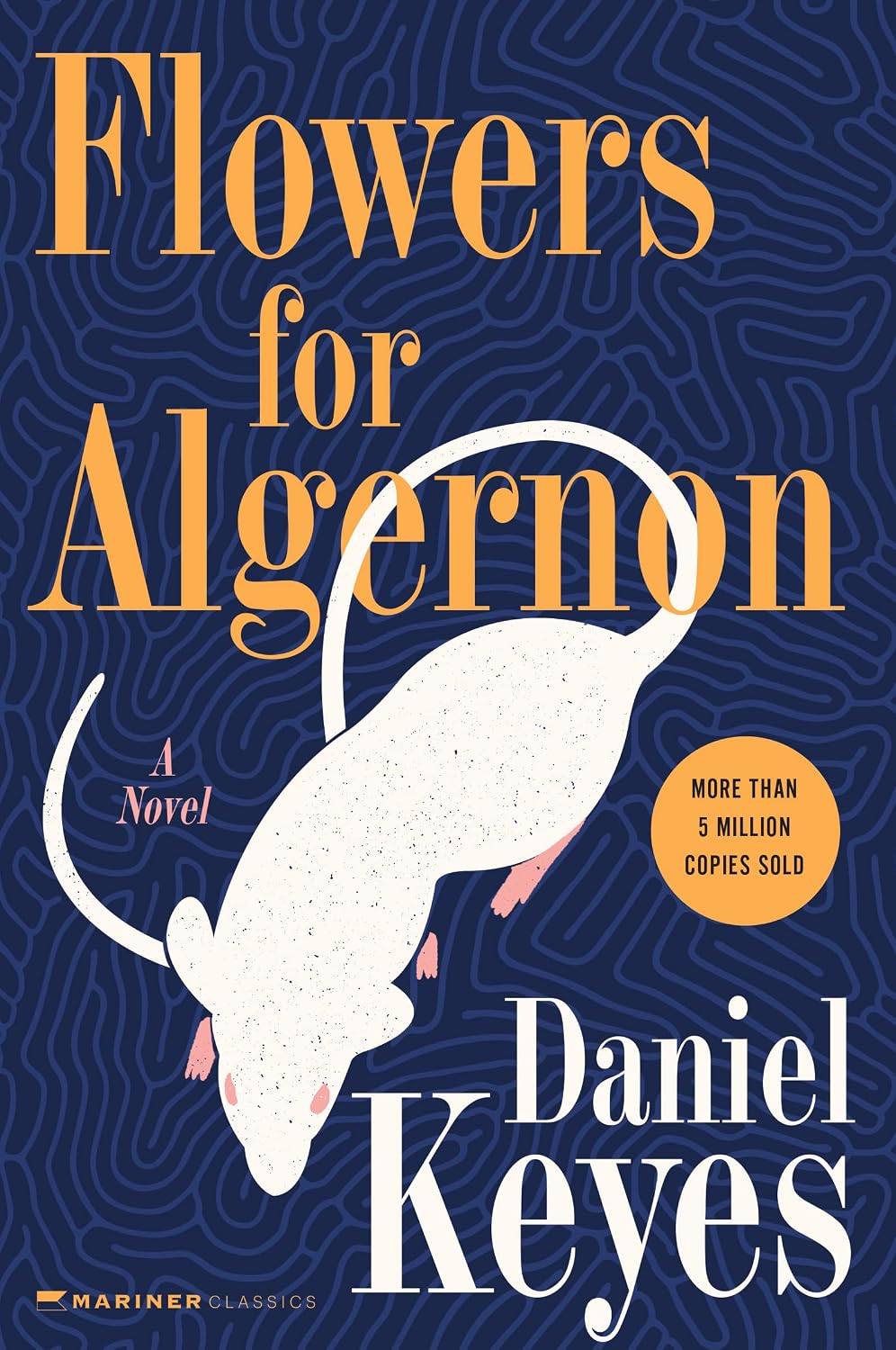
I finished the novel last night. Beautifully written. It has an unusual first-person narrative from Charlie Gordon, a man with an intellectual disability who is given an operation to increase his intelligence, which eventually faded quickly. Algernon is a mouse that undergoes the same operation. The whole book is a collection of Charlie’s dairy or “progress reports”. Reading them makes readers experience the rise and fall of his intelligence alongside him, as well as his gradual discovery of his past, the part of himself he had buried, and his eventual self reconciliation. Came to know the book when reading another book, Bewilderment by Richard Powers.
What stayed with me after closing the book was the experience of losing that intelligence. Charlie’s decline is much faster than ordinary aging, yet it brought to mind something most of us will face in one form or another. We will become slower. We will forget things we once knew, lose abilities we had come to rely on, and need more help from others. Charlie knows what is happening to him before he loses the ability to explain it. His intelligence allows him to see the decline clearly, but it cannot protect him from memory, shame, love, or time. Watching that loss unfold through his own writing gives the final part of the book an urgency I’ve rarely felt in any books or videos.
Intelligence Does Not Close the Distance
“Intelligence is one of the greatest human gifts. But all too often a search for knowledge drives out the search for love. This is something else I’ve discovered for myself very recently. I present it to you as a hypothesis: Intelligence without the ability to give and receive affection leads to mental and moral breakdown, to neurosis, and possibly even psychosis. And I say that the mind absorbed in and involved in itself as a self-centered end, to the exclusion of human relationships, can only lead to violence and pain.”
Charlie believes that being “smarter” will bring him closer to other people. Instead, he remains alone for a different reason. Others understand things he cannot do before the operation, and he understands things they cannot afterwards.
He begins to notice the cruelty behind old jokes, the insecurity of the scientists he once admired, and the small pretenses people rely on in everyday life. But being able to see through people does not make it easier to be close to them. Charlie often sees their weaknesses before he learns to live with them. Intelligence gives him clearer sight, not patience.
His emotional life does not develop at the same speed as his intellect neither. He can learn languages and challenge the scientists studying him, yet intimacy with two girls still brings back fears formed in childhood. Alice and Fay show two sides of this problem. Fay knows only the new Charlie. He can stay in the present with her. She does not remind him of who he used to be, and her opinion does not carry the same weight.
Alice knew him before the operation and was part of his early hope that becoming smarter would make him worthy of respect and love. To be close to her is to be seen as both the man he has become and the person he used to be. His adult mind understands that she cares for him, but the frightened child inside him still expects affection to turn into shame or punishment.
With increased intelligence and ability to observe himself, Charlie can understand why he reacts this way, but it does not make the reaction disappear. Knowing where a fear comes from is not the same as being free of it.
Seeing the Past Differently
“I see now that the path I choose through the maze makes me what I am. I am not only a thing, but also a way of being—one of many ways—and knowing the paths I have followed and the ones left to take will help me understand what I am becoming.”
Charlie was abandoned by his mom, Rose, because his retardedness. When he decides to meet his her again, he seems to be looking for recognition. Some part of him still wants to show her what he has become, as though his intelligence might finally disprove what she believed about him.
But when he sees her again, she is no longer the powerful figure he remembers from childhood. She is old, frightened, and unwell. This does not excuse the way she treated him. It allows Charlie to see her as a damaged person rather than only as the person who damaged him. Nothing in the past is repaired, and no one is suddenly innocent. Charlie simply sees more of it. His mother and sister are no longer only figures from his memories. They are people who were also shaped by fear, resentment, and confusion.
He begins to look at his younger self differently too. For much of the book, the intelligent Charlie treats the old Charlie almost as someone else: a frightened child who embarrasses him and gets in his way. Yet the operation did not create a new person. It changed the abilities of the person who was already there. Charlie eventually has to stop treating that earlier self as someone beneath him. The child he was did not need contempt. He needed care.
Algernon helps him understand this. At first, Charlie sees the mouse as a rival. Later, Algernon shows him what is going to happen to both of them. As Charlie cares for the declining mouse, he also begins to show more compassion toward the part of himself he had wanted to escape. Neither Charlie nor Algernon matters because of an unusual ability to solve problems. Their lives still matter when that ability is gone.
A Life Beyond Its Peak
“I am afraid. Not of life, or death, or nothingness, but of wasting it as if I had never been.”
Charlie’s decline is especially painful. As his intelligence grows, his language becomes more precise and complex. As it fades, words disappear and the spelling begins to break down again. We do not only hear that he is losing his abilities. We experience the loss through the way he writes. One of the book’s greatest strengths is its language. The prose changes as Charlie’s mind changes. The grammar, vocabulary, sentence rhythm, and even the emotional distance evolve alongside his intelligence, making the act of reading feel like living inside Charlie’s mind as it grows—and later, heartbreakingly, recedes.
It made me wonder how much of our identity rests on what we can do. Memory, judgment, independence, and the ability to express ourselves feel so central that losing them can seem like losing the person. Charlie does not become more worthy after the operation, and he does not become less worthy when its effects disappear.
People around him fail to see this. Coworkers at the Bakery make fun of him or treat him like a child. After they realize that Charlies is no longer the Charlies before the operation, they admire him, fear him, or resent him. In both cases, they respond to his level of intelligence. Charlie also falls into this way of thinking for a time, looking back at his former self with shame.
The book offers no easy comfort. Intelligence cannot save Charlie. Neither can love or self-knowledge. He cannot hold on to the version of himself he most wants to remain. But his life is not limited to what he can remember or explain at the end. Other people have known him. He has affected them. His life has mattered, even when he can no longer understand all the ways it has.
The flowers for Algernon are a tribute to a life that mattered. Perhaps they are also an invitation to extend the same compassion toward ourselves. We are no less ourselves when we’re ordinary, aging, or fading than when we’re at our best. Charlie quietly comes to this realization during his final visit to Matt’s barbershop. He tells nothing because there’s nothing to prove. There is nothing left to earn.